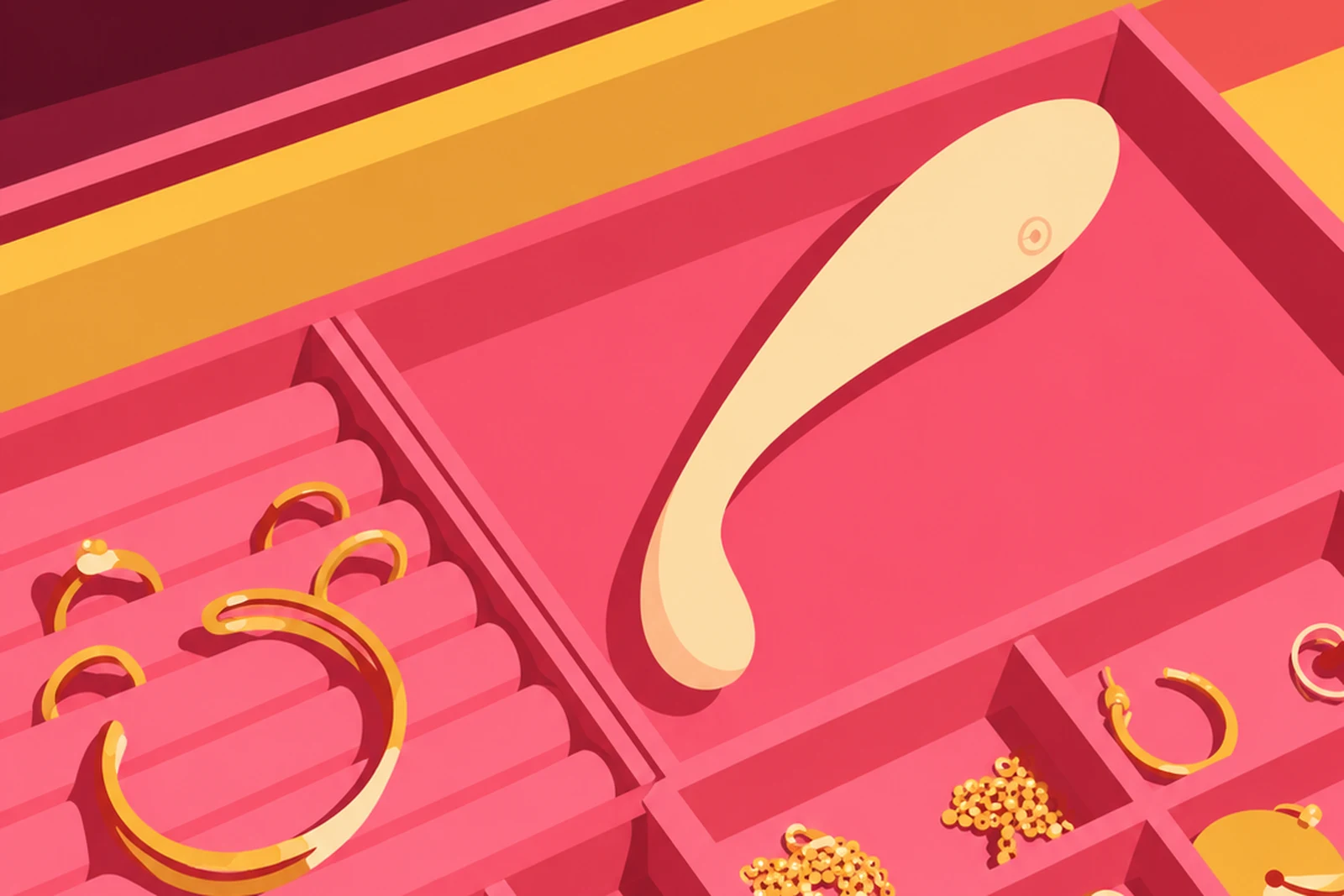
Celeste is soft enough to bend with one hand and firm enough to stay exactly where you bent it. Most internal massagers have a fixed curve and ask your anatomy to match it. Celeste asks you to set the curve first, which matters because the responsive tissue is not deep: it sits along the front wall of the vagina, nearest your pubic bone, within five to eight centimetres of the entrance. Reaching it is a question of angle, pressure and rhythm, not depth or speed.
Image needed
Hero image
Celeste held and bent into a curve between two hands so the flexibility is the first thing you notice. Soft directional light, deep plum ground.
2400 x 1000px, WebP. Mid to dark tone. Keep the left third clear, the headline sits there in large white type.
Before your first session
Charge it fully. A half-charged dual-motor device gives noticeably softer vibration at the tip.
Wash it before first use. Warm water, mild unscented soap, hands rather than a cloth so you can feel the seam where the external arm meets the body.
Water-based lubricant only, with every silicone device, because silicone lubricant slowly degrades a silicone surface. Internal use wants more than external, since the technique below relies on the tip gliding under pressure. See lube 101 for reapplying.
Take ten minutes to get turned on before anything goes in, and empty your bladder first. The front wall is unremarkable unaroused and becomes fuller, firmer and easier to feel once blood flow has increased.
Depth is the least useful thing Celeste gives you. Angle, pressure and rhythm are the three variables that decide whether the front wall answers.
Come-hither, not thrust: working the front wall
This is the whole skill, and it takes two or three sessions to learn.
Start with geometry. With Celeste in and the curve pointing toward your navel, the tip should sit five to eight centimetres deep, against the front wall rather than floating mid-canal. Feel for texture: in most people that stretch is slightly ridged and spongier than the smoother wall behind it, and it grows more obvious the more aroused you are. That texture is your landmark.
Now the pressure, where most people undershoot. The front wall wants firm, deliberate pressure, closer to the force you would use pressing a doorbell than to a light stroke, because the sensitive tissue sits behind the wall rather than on it. Press the tip upward and slightly forward, toward your pubic bone, and hold that pressure while you move.
Then the rhythm. A come-hither stroke is short. Press up into the wall, draw the tip back two or three centimetres toward the entrance with the pressure still on, then release and return. One full stroke every two seconds, far slower than most people expect. The movement comes from your wrist rotating, not your arm pushing in and out, and it is closer to kneading than to thrusting.
Then stop moving and let the motor work alone. Alternating is what builds: thirty seconds of strokes with the internal motor low, then twenty seconds of stillness with the tip pressed hard into the wall and the motor higher, then back. Front wall sensation accumulates and plateaus under unbroken identical stimulation, so the change is the point.
The external arm is not an afterthought. The front wall gets far more interesting once the clitoris is already engaged, and if the arm is not landing, that is a bend problem.
Worth knowing: If the first thirty seconds of front wall pressure feel like you need the bathroom, that is the urethra registering pressure through the wall, and it is completely ordinary. It usually resolves into something quite different if you stay with it.
One honest note on anatomy, because it changes how you search. Dissection work in the Journal of Sexual Medicine in 2017 found no discrete structure at the classic G spot location. What anatomists describe instead, in work such as Jannini and colleagues in Nature Reviews Urology, is a functional complex: urethra, internal clitoris and vaginal wall acting together. So stop hunting for a button. Work an area the size of a large coin with broad firm pressure, and let arousal make it findable. Our piece on what the G spot actually is has the evidence.
Image needed
Line diagram: working the front wall
Side-view cross-section of the vagina with Celeste inserted, curve rotated toward the navel, contact against the anterior wall. Show the come-hither motion as a small curved arrow, and mark clearly that it is a rocking movement rather than an in-and-out one.
1200 x 800px, PNG or SVG with transparent background. Simple line illustration, not a photo.
Your first session, step by step
One. Set the bend before you undress: curve the internal arm to roughly twenty degrees, hold for a count of five, and check it holds.
Two. Warm up without the device for at least ten minutes.
Three. Coat the internal arm generously along its whole length, and the entrance too.
Four. Insert slowly with the curve toward your navel, stopping when the internal arm is five to eight centimetres in and the external arm rests on the clitoris. If it is not landing, change the bend, do not push harder.
Five. Switch on at the lowest setting. Press the tip up into the front wall until the contact is unmistakable and hold it still for twenty seconds.
Six. Begin the come-hither stroke, one every two seconds, from the wrist. Alternate thirty seconds of stroking with twenty seconds of still, firm pressure at a higher intensity.
Seven. Afterwards, come down through the lower settings, remove Celeste slowly, and wash it.
Bending Celeste to your angle
The bend is a setting, not something you do once. Bend with both hands, thumbs on the outside of the curve, over two or three seconds rather than in a snap. Hold the shape for a count of five so the core settles, then check it stays put on a table. If it springs partly back, bend slightly past where you want it to finish.
Three starting angles are worth knowing. A shallow fifteen degrees suits a front wall close to the entrance and keeps the external arm flat and low on the clitoris. A firmer thirty to forty degrees drives the tip harder into the wall, and is the one to reach for when sensation has been vague rather than absent. A near-straight setting suits slow entry, pelvic floor work where you want something even to squeeze against, and sessions where you want broad internal fullness rather than a target.
Re-bend mid session, which is the part nobody thinks to do. If Celeste has drifted off the wall, take it out, adjust by ten degrees, go back in. Position changes the ideal bend too: on your back a gentle curve usually reaches, on all fours the wall presents at a steeper angle and a deeper bend earns its keep, sitting upright shortens the distance so a shallow bend with more pressure wins. Store it flat and unbent between sessions, because silicone that rests straight keeps its full range longer.
Image needed
Photo sequence: three bend angles
Three shots of Celeste bent to three different angles, shallow, medium and deep curve, in a row against the same background.
1200 x 800px, WebP. Product photography on a plain warm ground.
Modes, patterns and the app
Celeste runs on its buttons alone: both motors, every intensity, all the built-in patterns.
Two motors is the thing to exploit: internal motor low, almost a background hum, external arm high. Steady modes suit the finish; pulses, waves and build sequences suit the long middle stretch, because rhythm delays the flattening that unchanging stimulation causes. Our guide to vibration modes and patterns goes further.
The app adds patterns you build and save, sync to audio, a virtual partner mode driving both motors, and remote control.
Setting it up, and what each tile on the Play screen does, is covered in our guide to the Velvet Vibes app.
Together, and across distance
Celeste is built to stay in during partnered sex, so position is the question. Side-lying, one partner behind, leaves the most room for the external arm. Being on top gives you the angle and lets you shift your hips a centimetre at a time. On all fours, a deeper bend usually pays. Missionary tends to press the external arm flat, so set a shallower bend first.
Handing over the app goes better after a short conversation: agree the highest intensity either of you will use, and a word that means stop now. See using devices as a couple.
Across distance, take turns rather than one person always holding the phone. More in our long-distance guide.
For the app side of that, creating a room, inviting someone and passing control back and forth, see Love Bridge and long-distance sessions.
Cleaning, drying and storing
Wash Celeste immediately after use: warm water, never hot, mild unscented soap, hands rather than a cloth. Pay attention to the seam where the external arm meets the body and the base of the internal arm, where lubricant collects.
Pat it dry with a lint-free cloth, then leave it flat with air moving around it until it is dry everywhere, underside included. No heat. In a humid Indian summer, give it extra time.
Store it flat, unbent, cool and dark, in its own pouch and not touching other silicone. In a shared house, a fabric pouch inside a hard case reads as anything at all. Our cleaning and storing guide has the general rules.
When it is not working
Vague sensation, or nothing much. In order of likelihood: not enough pressure into the wall, not aroused enough, the bend too shallow so the tip sits mid-canal, too deep, or the battery low.
The external arm will not stay on the clitoris. A bend problem. Add ten degrees of curve, or take ten off if the arm is riding high.
It feels like too much straight away. Drop to level one, use more lubricant, and let it sit still.
It will not charge. Wipe the magnetic contacts on both sides, and lay the device flat so the cable is not pulling the magnet sideways.
It will not turn on. Check the travel lock first, the commonest cause of a device that seems dead.
It will not pair. Power the device off for five seconds, force-close the app, and toggle Bluetooth.
It will not hold a bend. Bend slightly past your target and hold a full five seconds. If it still springs back, a week lying flat restores it.
Questions we get asked
I cannot find my G spot. Is something wrong with me? No. There is no discrete organ there, only the functional complex described above: urethra, internal clitoris and vaginal wall acting together. Broad firm pressure across an area beats hunting for a point.
How far in should Celeste go? Five to eight centimetres for most people. Deeper moves the tip past the responsive tissue rather than closer to it.
Why does it make me feel like I need the bathroom? The urethra runs directly behind the front wall, so pressure there reads as a bladder signal at first. It generally settles within thirty seconds.
Can I use Celeste for pelvic floor work? Yes, as a feedback tool. Squeeze around the internal arm for three seconds, release for three, ten to fifteen repetitions, three sets a day. Mayo Clinic guidance: results show over weeks, and relaxing fully between repetitions matters as much as the squeeze. Full method in our kegel guide.
Will it desensitise me? No. Survey research on vibrator use found a minority report temporary numbness that resolves on its own within a day, with no evidence of lasting change.
Sources
- Hoag N, Keast JR, O'Connell HE. "The 'G-Spot' Is Not a Structure Evident on Macroscopic Anatomic Dissection of the Vaginal Wall." Journal of Sexual Medicine, 14(12), 1524-1532, 2017.
- Jannini EA, Buisson O, Rubio-Casillas A. "Beyond the G-spot: clitourethrovaginal complex anatomy in female orgasm." Nature Reviews Urology, 11(9), 531-538, 2014.
- Puppo V. "Anatomy and physiology of the clitoris, vestibular bulbs, and labia minora with a review of the female orgasm and the prevention of female sexual dysfunction." Clinical Anatomy, 26(1), 134-152, 2013.
- Herbenick D, Reece M, Sanders S, Dodge B, Ghassemi A, Fortenberry JD. "Prevalence and characteristics of vibrator use by women in the United States." Journal of Sexual Medicine, 6(7), 1857-1866, 2009.
- Mayo Clinic. "Kegel exercises: A how-to guide for women." Mayo Foundation for Medical Education and Research, 2023.
 ← How To Use